Inbound and outbound marketing: combining them in B2B without spending 1.5 hours a day on it
By Romain QUECHON · Published on September 24, 2026 · Updated on September 26, 2026
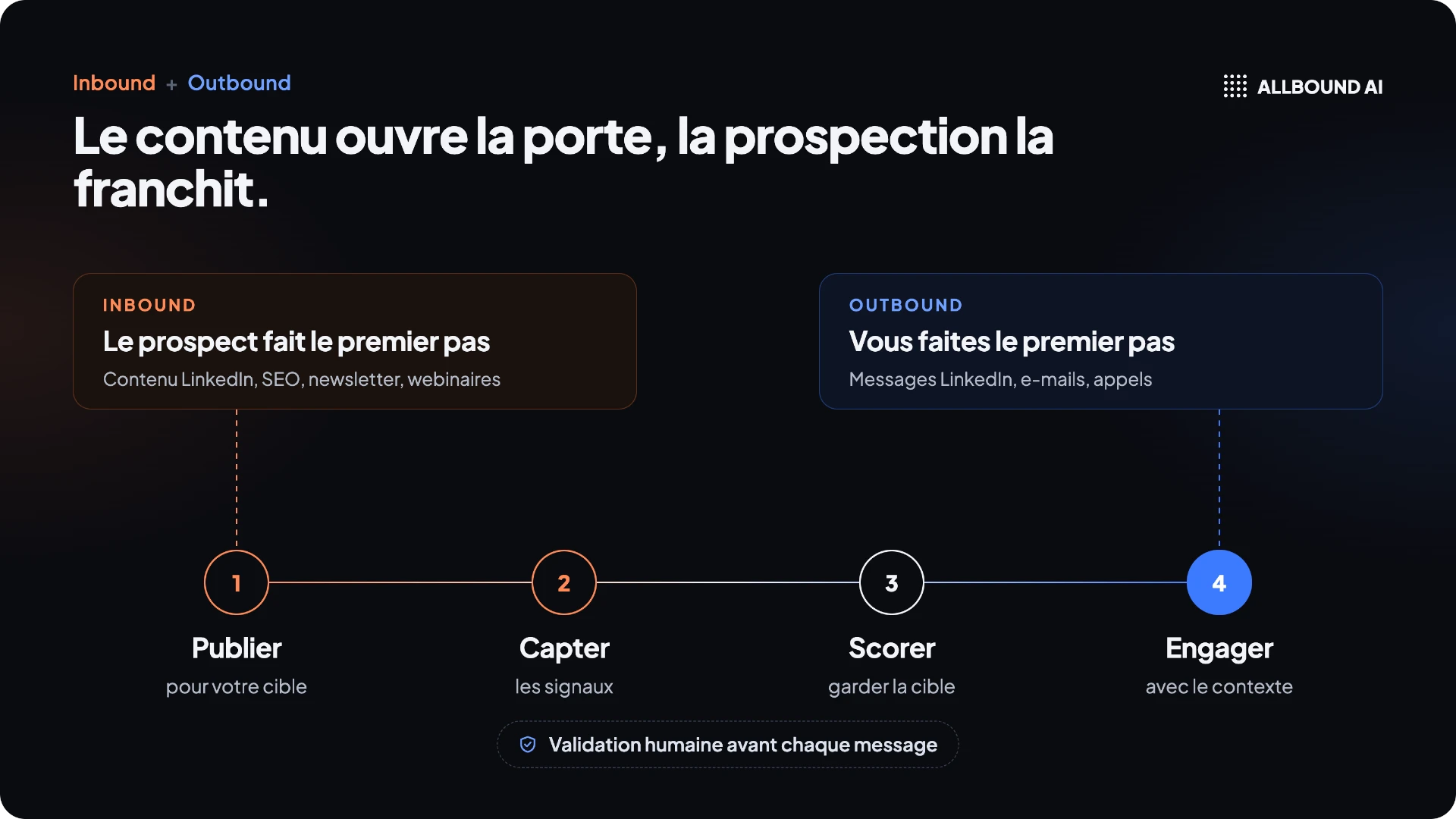
Inbound attracts prospects with content. Outbound goes out and finds them directly. In B2B, combining the two means using interactions with your content as a signal to trigger targeted outreach: content opens the door, prospecting walks through it.
Antoine Blanchys (Mentor CEO) posts on LinkedIn every day. 49,000 followers, a spot in the LinkedIn Favikon top 100 within 1 year and 3 months, tens of thousands of views every month. He still had one problem: turning that visibility into meetings with CEOs took him 1.5 hours a day, done by hand.
His case sums up the topic of this guide. Inbound without outbound is an audience that does not convert. Outbound without inbound is cold prospecting that runs out of steam. Here is how to connect the two, step by step.
Inbound and outbound marketing: definitions and differences
Inbound marketing: bringing the prospect to you
Inbound covers everything that attracts a prospect without soliciting them: LinkedIn posts, SEO articles, newsletters, webinars, case studies, lead magnets. The prospect comes to you when they are looking for an answer. You build trust, not a volume of contacts.
Outbound marketing: going out to find the prospect
Outbound means taking the initiative: identifying a decision-maker, then contacting them directly, on LinkedIn or by email. You control the target and the timing. You also reach people who have never heard of you.
Inbound and outbound: the comparison
| Inbound | Outbound | |
|---|---|---|
| Who makes the first move | The prospect | You |
| Typical channels | LinkedIn content, SEO, newsletter, webinars | LinkedIn messages, emails, calls |
| Time to first results | Long | Short |
| What you control | The message, not who shows up | The target and the timing |
| Main risk | An audience that does not convert | Prospecting perceived as intrusive |
The two approaches are not opposites. They answer the same question, who to contact and when, with two halves of the information.
Why inbound alone is not enough
An audience is not a pipeline. Antoine had the views, the comments, the likes. What he was missing was the next step: spotting, among those interactions, the CEOs who matched his target, then writing to them at the right time.
Done manually, this step is costly. Segmenting, researching intent, writing a personalized message: 1.5 hours a day in his case. Not scalable. Not sustainable over time.
I do everything manually: segmentation, intent research, personalized messages. It takes me 1.5 hours a day and it is not scalable. (Antoine Blanchys, Mentor CEO) (translated from French)
Why outbound alone runs out of steam
The reverse also exists. Prospecting without content arrives without context: the prospect does not know you, has no reason to reply, and is already receiving plenty of outreach. Your message can only rely on their job title and company.
A prospect who commented on your post the day before already has context with you. Your message is no longer an interruption, it is the continuation of an exchange. That is the whole difference between cold prospecting and signal-based prospecting.
How to combine inbound and outbound in 4 steps
The method follows a precise order. Content produces interactions, interactions become signals, signals trigger conversations.
1. Publish to get your target audience reacting, not to get views
Content exists first to get the right people reacting. A post that gets a few executives from your target audience reacting is worth more than a viral post among people who will never buy. Choose your topics based on the problems your customers describe during meetings.
2. Capture every engagement signal
Every interaction is a signal: comment, like, new follower, profile visit, newsletter signup, lead magnet download, webinar registration. Taken one by one, they are weak. Centralized in one place, they show who is interested in you, and on what topic. More detail here: using LinkedIn engagement signals.
3. Score before you reach out
Not every engaged account is a prospect. A student who likes a post and a CEO from your target who comments on it do not carry the same value. Scoring combines the profile (job title, company, industry) with the intensity of the engagement to rank leads. You only contact the top of the list. See AI lead scoring on LinkedIn.
The rule: a lead outside your target does not get a message, even a highly engaged one. Time spent on a bad lead is time taken away from a good one.
This is the building block Antoine uses every day: the Allbound AI platform gathers the people engaging with his profile and his content, then scores them automatically. See how the implementation program works.
4. Engage with the context of the signal
The message starts from the signal, not the pitch. You pick up the topic that got the prospect to react, add something extra (a case study, a resource), then propose a conversation. Every message is reviewed by a human before it is sent.
The full sequence, day by day, is detailed in the Allbound strategy guide.
The Antoine Blanchys case: from LinkedIn content to meetings
- Target: CEOs.
- Starting point: one post a day, 49,000 followers, 1.5 hours a day of manual prospecting.
- Signals captured: comments, likes, new followers, profile visits, newsletter and lead magnet signups.
- Channel: LinkedIn, with human approval before every message.
- Result: 90% of the processes automated overnight, according to Antoine.
Why it worked: Antoine already had the audience. The platform did not create the interest, it turned existing interest into conversations.
The key today is turning content into relationships. (Antoine Blanchys) (translated from French)
The masterclass co-hosted with Antoine drew more than 300 registrants for a 1 hour 10 minute live demonstration. Watch the replay: the inbound and outbound masterclass with Antoine Blanchys.
The math
1.5 hours a day of manual prospecting, over 20 working days, adds up to 30 hours a month. That is the time Antoine spent sorting, searching, and writing, before a single conversation even happened. Run the numbers with your own time: that is the real cost of your manual outbound.
Limits of the method
Combining the two assumes you have content that gets your target audience reacting. Without an audience, there are no engagement signals: you then need to rely on other signals, such as a job change or a funding round, while your content builds momentum.
Another limit: poorly tuned automation turns a good signal into a generic message. Human review is not optional.
5 tips to apply this week
- Start from your engaged accounts, not a purchased list: your last 10 engaged accounts in your target audience are your first 10 messages of the week.
- Mention the signal in the first sentence: the prospect must understand within seconds why you are writing to them.
- Ignore engaged accounts outside your target: a like does not make a prospect.
- Track the origin of every meeting: content, signal, or direct prospecting, to know what to double down on.
- Review every message before sending: automation prepares, the human approves.
Frequently asked questions about inbound and outbound
What is the difference between inbound and outbound marketing?
Inbound attracts prospects with content: they come to you when they are looking for an answer. Outbound means contacting them directly, on LinkedIn or by email. Inbound builds trust over time, outbound gives you control over the target and the timing.
Do you have to choose between inbound and outbound in B2B?
No. Both answer the same question, who to contact and when, with two halves of the information. Content produces interactions, these interactions become signals, and signals decide who gets contacted.
How do you turn LinkedIn engagement into meetings?
In four steps: publish content to get your target audience reacting, capture all engagement signals in one place, score the engaged accounts to keep only those matching your target, then write to them based on the topic that got them to react, with human approval before every send.
Where should you start: inbound or outbound?
Start with what you already have. If you have an audience, use the engagement signals it produces. If you don't have one yet, start outbound prospecting on other signals, such as a job change or a funding round, and publish content in parallel to build tomorrow's signals.
Romain QUECHON, founder of Allbound AI (formerly The World of AI). More than 60 clients supported, with 10 to 15 meetings generated per month on average for implementation program clients. See Romain's background · Follow me on LinkedIn