B2B content strategy: turn every piece of content into a lead pipeline
By Romain QUECHON · Published on September 24, 2026 · Updated on September 26, 2026
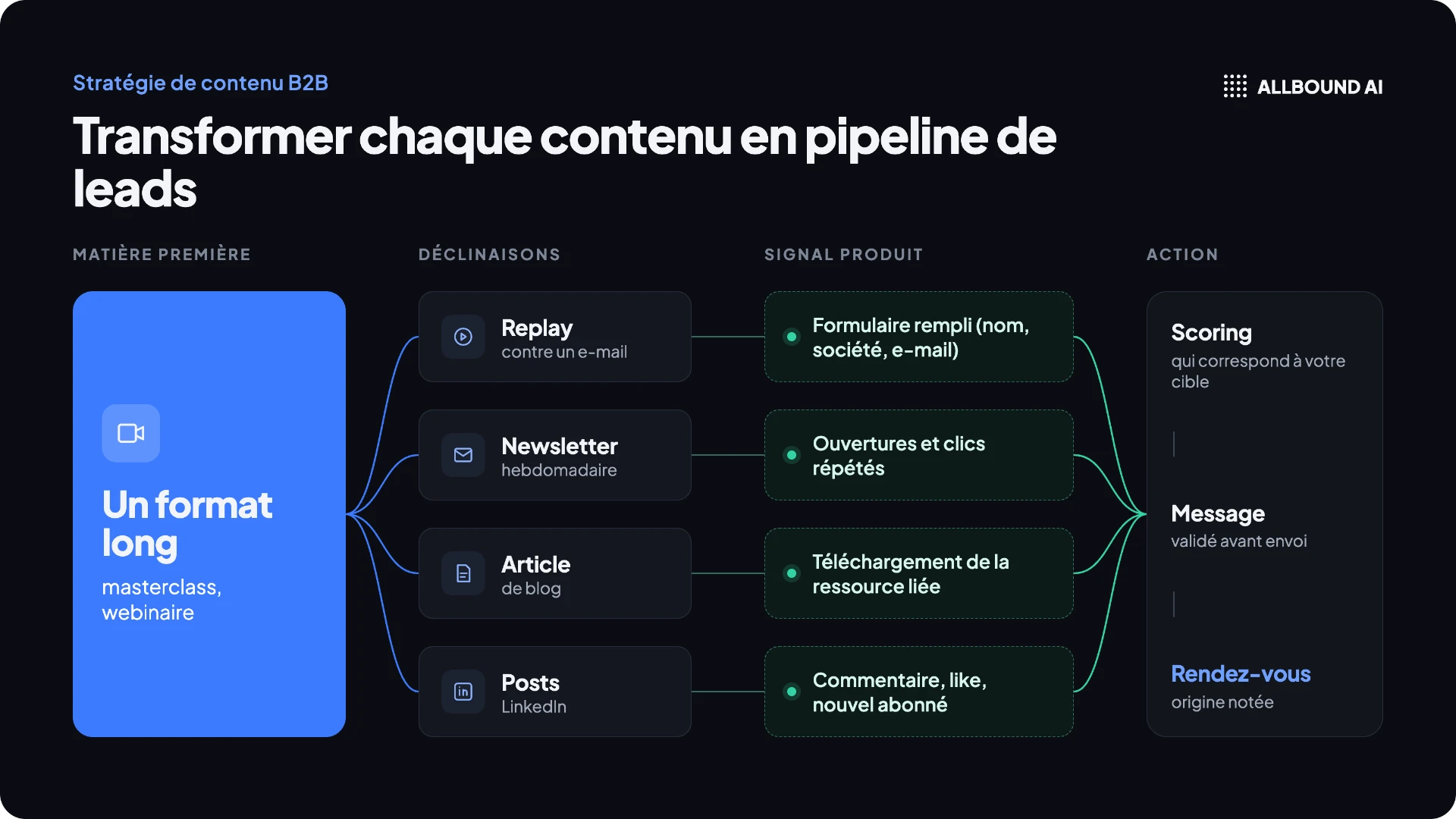
A pipeline-focused B2B content strategy produces few long-form pieces, repurposes them into short-form formats, then uses every interaction as the starting point for a sales conversation. Content does not just serve visibility: it qualifies and it triggers.
At Allbound AI, this platform has been running since 2023, back when it was called The World of AI: a blog, a weekly newsletter sent to about 6,000 contacts, three LinkedIn posts a week, and masterclasses whose replays serve as lead magnets. This playbook describes the mechanics, and what we get from it on the prospecting side.
It focuses on one piece of the Allbound strategy: content. For how it connects with direct prospecting, see also how to combine inbound and outbound.
Why content is the engine of a B2B pipeline
Useful content does three things. It attracts the right people. It gets them to raise their hand: a comment, a signup, a download. And it gives your prospecting a topic to talk about. Most teams stop at the first one.
Allbound uses the other two as well: every piece of content feeds your prospecting sequences, and every prospecting message points back to a piece of content. One channel working for the other, not two channels ignoring each other.
Step 1: one piece of content per stage of the buying journey
Good content answers the question your prospect is asking at that exact moment. Three stages are enough to structure your editorial plan.
| Stage | Prospect's question | Formats | Role in the pipeline |
|---|---|---|---|
| Awareness | Do I really have a problem? | LinkedIn posts, SEO articles | Attract and produce the first signals |
| Consideration | How do others solve it? | Webinars, newsletter, guides | Capture an email, qualify interest |
| Decision | Why you? | Case studies, demos, comparisons | Reassure before and after the meeting |
The rule: start from the objections you hear in meetings, not trending keywords. Content that answers a real objection works twice: in inbound to attract, in outbound as proof.
Step 2: produce from a long-form format
Creating every piece of content from scratch exhausts any team. The rule: one long-form format, repurposed into short-form formats. The long-form format is the raw material, the short-form formats are the distribution.
The inbound and outbound masterclass example
The masterclass co-hosted with Antoine Blanchys, a customer of the platform, brought together more than 300 registrants for 1 hour and 10 minutes of live demo. Here is what it became:
- A replay gated behind a first name, last name, company, and email: every viewing creates an identified lead.
- A dedicated page featuring Antoine's quotes and the key points of the demo.
- A case reused in blog articles, like this guide on inbound and outbound.
The same logic runs every week on a smaller scale: a newsletter becomes a blog article, which becomes a LinkedIn post. One topic worked on once feeds three channels.
The value rule
Each repurposed piece must teach the reader something. An excerpt with no takeaway is noise, not distribution. Give first, sell second.
Step 3: activate every piece of content in inbound and outbound
This is where content becomes pipeline. Each format produces a type of signal, and each signal calls for a specific action.
| Content | Signal produced | Outbound action |
|---|---|---|
| LinkedIn post | Comment, like, new follower | A message that picks up the post's topic, if the profile fits your target |
| Webinar replay | Form filled out (name, company, email) | A follow-up message about the part of the replay relevant to their company |
| Newsletter | Repeated opens and clicks | Outreach to the most engaged readers in your target |
| SEO article | Download of the linked resource | A follow-up with a case study from the same industry |
The rule: you don't contact everyone. The signal tells you who is interested, lead scoring tells you who fits your target. You need both.
This is the role of Allbound AI's engaged-prospect detection: it brings these signals together in one place, scores them, then drafts messages you approve before sending. Explore the implementation program.
I now have a real platform I trust. (translated from French) (Antoine Blanchys, Mentor CEO)
The 3 essential building blocks
- A single database that centralizes contacts, companies, and interactions: without it, your signals stay scattered across channels.
- A signal detection and scoring block, to know who to contact first.
- A LinkedIn engagement block with human approval, to send the right message at the right time.
The trap: stacking tools that don't talk to each other. Data gets fragmented, and the link between a piece of content and a meeting becomes impossible to measure.
The limits of the method
This mechanism needs consistency before it produces usable signals: an audience is built over months, not two weeks. It also requires tracking the origin of every meeting, otherwise there is no way to know which content truly works.
Finally, a mediocre long-form format produces mediocre repurposed pieces. The quality of the long-form format decides everything else.
5 tips to apply this week
- Choose one long-form format per quarter: a webinar or masterclass that will supply material for everything else.
- Put the replay behind a short form: every viewer becomes an identified lead.
- Repurpose every newsletter into an article, then a post: one topic, three channels.
- Link every piece of content to an outbound action: a signal with no follow-up is a lost lead.
- Track the origin of every meeting to know which content deserves a follow-up.
Frequently asked questions about B2B content strategy
What is a pipeline-focused B2B content strategy?
It is a strategy that produces few long-form pieces, repurposes them into short-form formats, then uses every interaction with that content as the starting point for a sales conversation. Content does not just serve visibility: it qualifies and it triggers.
What content should you create to generate B2B leads?
One piece of content per stage of the buying journey: LinkedIn posts and articles for awareness, webinars, a newsletter, and guides for consideration, case studies and demos for decision. Consideration content is what captures an email most easily.
How do you repurpose a webinar into several pieces of content?
The replay becomes a lead magnet gated behind a short form. The best moments feed a dedicated page, video clips, articles, and LinkedIn posts. Each repurposed piece must teach the reader something.
How do you measure what a piece of B2B content delivers?
By tracking the origin of every meeting: the content, the signal that triggered the outreach, and the channel. Without this information, there is no way to know which content truly works and which deserves a follow-up.
Romain QUECHON, founder of Allbound AI (formerly The World of AI). More than 60 clients supported, with 10 to 15 meetings generated per month on average for implementation program clients. See Romain's background · Follow me on LinkedIn