Allbound: The Complete B2B Strategy Guide, From Intent Signals to Meetings
By Romain QUECHON · Published on September 24, 2026 · Updated on September 30, 2026
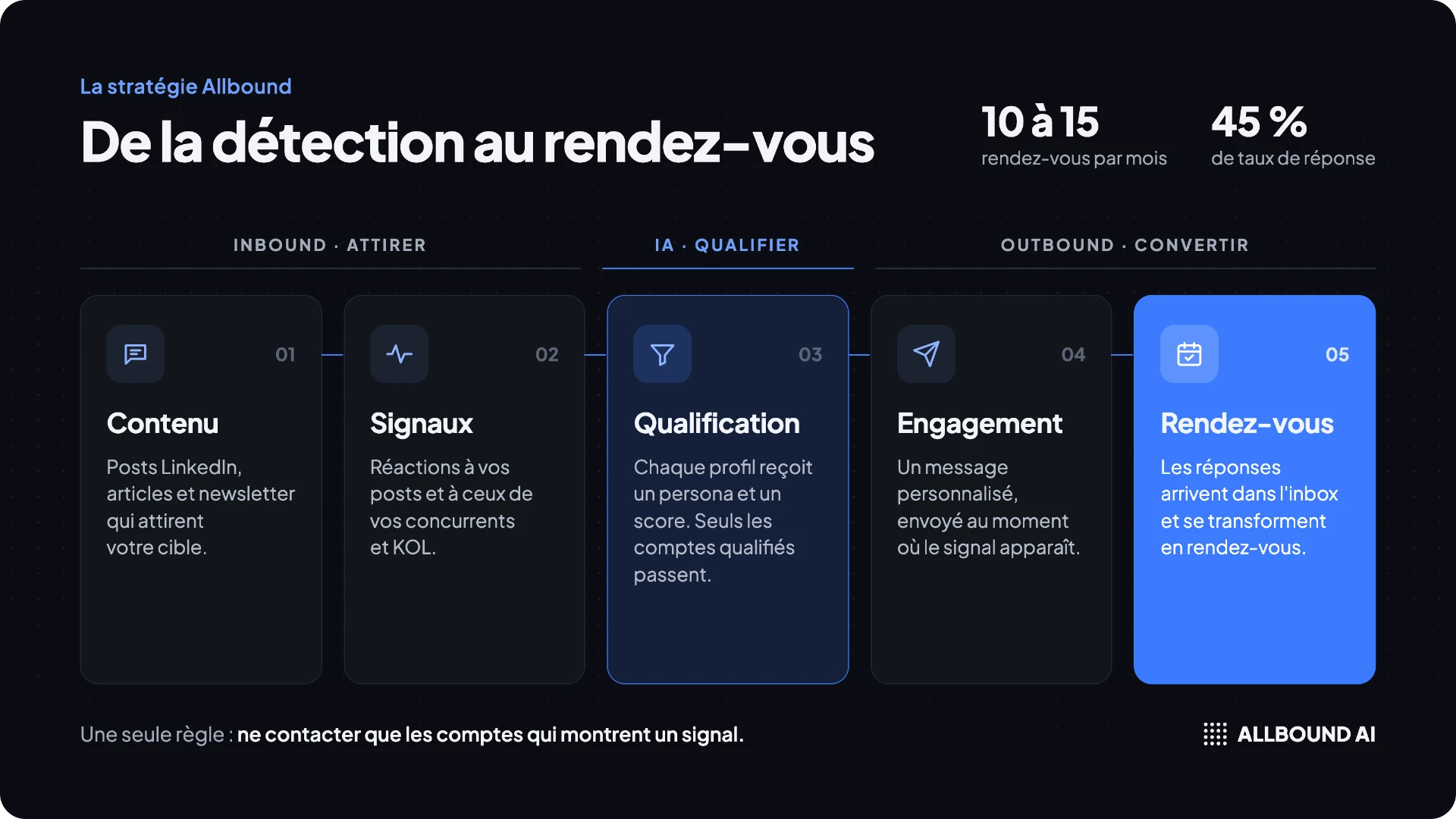
10 to 15 meetings per month on average for our clients in our implementation program. 45% average reply rate. One rule behind these numbers: only contact accounts that show a signal, the moment it appears.
Here is the complete method, step by step. And the plan to launch it in 30 days.
Allbound in one sentence
Allbound is a B2B acquisition strategy that brings together inbound (the content that attracts) and outbound (the prospecting that reaches out) around a single piece of data: the prospect's intent signals.
Inbound attracts, but slowly. Outbound moves fast, but loses steam as soon as targeting or timing slips. Allbound does not choose between the two. It connects them to the same stream of signals.
Fewer messages. More context. The right moment.
What is Allbound?
Allbound combines the attraction of inbound and the activation of outbound in a continuous journey. It is also called allbound marketing.
A commented post, a visit to the pricing page, a job change: in a classic setup, these are isolated events. In Allbound, each one becomes a piece of data that tells the team who to contact, why now, and with what message.
- Inbound builds trust: useful content, case studies, webinars, consistent presence.
- Outbound turns attention into conversation, through a direct and contextualized approach.
- Data connects the two. It decides, not the campaign calendar.
- Human oversight validates before sending. AI prepares, the human decides.
The question is no longer "inbound or outbound?" It is: who is showing a signal, which channel respects their context, and which action moves the relationship forward?
Allbound, inbound, outbound: the differences
| Inbound | Outbound | Allbound | |
|---|---|---|---|
| Principle | Attract with content | Reach out to the prospect | Engage those who show a signal |
| Starting point | The prospect comes to you | A list of targets | A signal on a targeted account |
| Early results | Slow | Fast | Fast, and they improve over time |
| Strength | Trust, authority | Control over volume | Right account, right moment, right message |
| Limit | Little control over who shows up | Loses steam without context | Requires shared targeting and data |
Why adopt an Allbound strategy in B2B?
To contact fewer people. Better. At the right time.
- Sales effort goes to accounts that show a need, not the entire target list. Sales reps' time is the scarcest resource: it should not go into cold accounts.
- Every message starts from real context. The prospect understands why you are contacting them: that is the difference between a message that gets read and one that gets ignored.
- Content finally serves sales. It opens, reassures, and revives conversations, instead of living alone on the blog.
- Marketing and sales share the same definition of a prospect, and therefore the same metrics.
1. Align marketing and sales before automating
The platform first. Automation second.
Automating fuzzy targeting just produces noise faster. An Allbound strategy fails when marketing sends contacts that sales consider off target, or when sales reps ignore the content that would reassure their prospects.
Define a shared ideal customer profile
- Priority industries, company sizes, and geographies.
- Functions involved: decision maker, user, influencer.
- Urgent problems your offer actually solves.
- Events that make reaching out relevant.
- Exclusion criteria. This is the line most teams forget: an account that looks appealing on paper but is off target costs more than one you ignore.
Set a shared language for the pipeline
Targeted account, engaged lead, qualified lead, opportunity, relevant meeting: decide together what each status means.
For each stage, three things: an owner, an expected action, a maximum handling time. A status with no owner is a lead going cold.
Create a short feedback loop
Every week, sales reports back three things:
- objections heard;
- phrasing that gets replies;
- signals that opened the best conversations.
Marketing turns this into content. Campaigns reuse that content to open new conversations. The loop is closed.
2. Detect the intent signals that matter
An intent signal is a behavior or a change that increases the likelihood that an account has a need.
Increases the likelihood. Does not guarantee it. No single signal proves on its own that a purchase is imminent: its value depends on the account's profile, its freshness, and how it combines with other clues.
The four families of signals
Two logics. Reactive: the prospect raises their hand, you respond fast. Proactive: you go find the change before they do.
Reactive signals, to handle first:
- Proprietary signals: a visit to a strategic page, a download, a webinar signup, a reply to a campaign, repeated visits to the site.
- Relationship signals: an accepted connection, a referral, a former client who joined a new company, a shared contact.
Proactive signals, to go find:
- Account related signals: a funding round, hiring, entering a new market, team growth, a new offer.
- Individual signals: a job change, a recent role change, publishing about a problem, interacting with content.
A signal most teams do not use: people who comment on your competitors' posts or on influential voices in your market. They are publicly declaring interest in the problem you solve. Citing this signal in your first message answers the question "why me, why now" right away.
Evaluate the strength of a signal
Three dimensions: closeness to your offer, freshness, level of engagement.
An old visit to a general article: a weak signal. Three visits to your pricing page this week, followed by a like on your latest post: a strong signal. Same account, two different treatments.
Avoid false positives
A download is not a purchase intent. Check the role, the company, the probable need, and other interactions before acting.
The rule: qualification reduces noise before automation accelerates anything. Not the other way around.
3. Enrich and segment without losing context
A list of prospects is not a strategy.
Enrichment has one goal: give enough context to decide whether a contact deserves an action. Not pile up columns.
The data that actually helps
- Professional identity: role, seniority, level of responsibility, scope.
- Account data: activity, size, growth dynamics, market served.
- Sales context: likely problem, relevant offer, proof to use.
- Engagement history: content viewed, interactions, replies, last action.
- Trigger signal: the precise event that justifies the timing.
The enrichment rule: light for everyone, deep for the best. A thorough account analysis (auditing their website, classifying their activity) costs a lot per lead. Save it for high scores: at volume, it does not pay off.
Segment by situation, not just by persona
Two executives in the same industry can call for two opposite approaches. One is discovering the problem. The other is already comparing solutions. Combine profile, maturity level, and observed signal:
| Situation | Action |
|---|---|
| Priority account, no engagement | Educational content, then a light touch outreach |
| Priority account, recent signal | Direct message, contextualized by the signal |
| Engaged but incomplete inbound lead | Enrichment, qualification, then sales activation |
| Old opportunity that became active again | Personalized follow up based on history |
4. Build an actionable Allbound scoring model
Scoring crosses two things: account fit and observed intent.
A score is a decision, not a grade. If it does not trigger a precise action, it is decorative. To go further: AI lead scoring.
A simple model with four dimensions
- Company fit: match with your ideal customer profile.
- Contact fit: real influence over the problem and the decision.
- Intent: strength, number, and recency of signals.
- Engagement: replies, visits, clicks, interactions with your content.
Start with three levels. Not a formula with twelve variables.
| Priority | Action |
|---|---|
| High | Fast human action |
| Medium | Personalized sequence and relevant content |
| Low | Nurturing, waiting for a new signal |
A detail that changes everything: the same lead must always get the same score. On the platform, the scoring agent is set so there is no randomness. Without this stability, you cannot tell whether a changing score comes from the lead or from the model.
Add negative points
A good score also knows how to downgrade: off target company, student, competitor, no need, prolonged inactivity, explicit refusal.
Every negative point protects sales time.
5. Engage the prospect on the right channel
A LinkedIn sequence does not repeat the same message six times. Each step has a role: make your name familiar, bring proof, open a conversation, make the meeting easy.
No "just following up." Every touch brings something new. See also the AI LinkedIn prospecting method.
A typical Allbound sequence
16 days. 6 touches. 2 channels.
- Day 1: a useful interaction with the prospect's content or a post they shared.
- Day 2: a low key LinkedIn invitation, with no pitch. Counterintuitive, but an invitation that sells nothing gets accepted more easily.
- Day 4: a message contextualized by the observed signal, centered on a problem hypothesis.
- Day 7: a case study, a playbook, or a webinar excerpt tied to their context.
- Day 11: a short email, one piece of proof, one simple question.
- Day 16: a closing follow up. Or back to nurturing if no new signal appears.
The stop rule matters as much as the sequence: no new signal, no new touch.
Write a contextualized message
Four elements: the observed context, the need hypothesis, relevant proof, an easy question to answer. Useful personalization talks about the prospect's situation. Not a detail found at the bottom of their profile.
I noticed your sales team is hiring across two markets.

At this stage, several of our clients struggled to prioritize the accounts that were truly active.

How do you currently identify which prospects to contact first?
Hi {{first name}}, thanks for connecting.

I'm reaching out because {{competitor signal}}, so I'm guessing prospecting is a topic on your mind.

I'm mapping the market right now. Where do you stand?

A) fully manual
B) a sequencing tool, but writing is still manual
C) targeting and writing are already partly automated

Just the letter is enough for me.
Why this format works: replying only costs a letter, so the reply rate goes up. And the letter chosen is the maturity level. Qualification happens in the reply, with no second exchange.
{{first name}}, I won't follow up again, promise.

If one day you want to see what prospecting looks like when targeting and writing are handled upstream, let me know: I'll show you the platform in 20 minutes.

Otherwise, all the best.
Use retargeting with measurement
A targeted account views content or clicks on a campaign? A reminder ad can reinforce familiarity before the message. It sets the stage. It does not replace the message.
6. Turn content into a sales accelerator
Content that no sales rep has ever sent is brand content. Not Allbound content. Every resource should help move a conversation forward, answer an objection, or prove a result.
| Content | Journey stage | Role |
|---|---|---|
| Educational article | Discovery | Create awareness |
| Comparison | Evaluation | Structure the decision |
| Case study | Evaluation | Reassure on execution ability |
| Webinar | Engagement | Add depth, reveal interest |
| Checklist | Taking action | Make the next step concrete |
| Customer review | Decision | Reduce perceived risk |
Example of a webinar used in a sequence: the masterclass on the inbound outbound combo.
Link each piece of content to a stage, an objection, and a sales action. You will know what to send depending on the situation, instead of sharing the same resource with everyone. Detailed method: turning your content into a pipeline.
On the measurement side, every LinkedIn post is tracked on four counters: comments, reactions, reposts, impressions. Comments count double: each commenter is a signal to qualify.
7. Keep useful human oversight
Automate the tasks. Not the decisions.
| The platform handles | The team keeps |
|---|---|
| Continuous signal monitoring | Validation of positioning and promises |
| Qualification and prioritization by your criteria | Control of high stakes messages |
| Message preparation based on context | Handling replies and objections |
| Orchestration of sequences and follow ups | Running meetings and negotiation |
| Content creation and repurposing | Choice of segments, priorities, and offers |
| Centralizing learnings | Decision to adjust strategy |
AI detects, enriches, scores, prepares. The human validates, replies, sells.
8. Measure performance end to end
Open rates and connection volume say nothing about revenue. Measure the progression from detected signal to potential revenue.
Metrics to track
- Coverage: target accounts tracked, share with a recent signal.
- Quality: rate of leads validated by sales, disqualification reasons.
- Engagement: accepted connections, positive replies, conversations started.
- Conversion: qualified meetings, opportunities created, pipeline progression.
- Efficiency: time between signal and outreach, human time saved, cost per opportunity.
- Content: resources that actually influenced a reply, a meeting, an opportunity.
The calculation that frames everything else: start from your target number of conversations and work back up the funnel. At the average reply rate observed on the platform (45%), opening 20 conversations requires contacting about 45 prospects. Redo the math with your own rates.
Set your decision thresholds before launching
- First message reply rate under 5%: the angle is not working. Change the premise, not the wording.
- Reply rate above 15%, but no meetings: the bridge between conversation and meeting is too weak. Strengthen the end of the sequence.
- Very uneven replies across maturity levels: the problem is upstream, in targeting. Not in the sequence.
Set up an improvement loop
Every month, identify the segment, the signal, the message, the channel, and the content that produce the best conversations.
Keep what works. Stop what makes noise. Test one variable at a time: otherwise, you will never know which one made the difference.
9. Scale without losing relevance
Scaling is not about increasing volume. It is about making the method repeatable, measurable, and transferable.
- Document targeting criteria, signals, and priority rules.
- Build a library of messages by situation, objection, and maturity level.
- Give an owner to every stage of the journey.
- Automate repetitive tasks, not judgment.
- Open a new segment only once the previous one produces stable results.
- Keep a regular human review of replies and meeting quality.
The minimal Allbound team
Three responsibilities, even if carried by a single person: strategy and offer, content and demand, sales activation and conversion. The platform connects the execution. Accountability for the result stays with a named owner.
A 30 day Allbound action plan
One segment. Four weeks. One deliverable per week.
Week 1: frame it
Deliverable: a one page ICP sheet.
- Choose a single priority segment.
- Formalize the ideal customer profile and exclusion criteria.
- List five observable intent signals.
- Define pipeline stages and their owners.
Week 2: prepare
Deliverable: a validated sequence.
- Enrich a first group of accounts.
- Create three score levels, with their negative points.
- Match a piece of content and a proof point to each situation.
- Write a short LinkedIn sequence, reviewed by a human.
Week 3: launch
Deliverable: a reply log.
- Activate the campaign at a controlled volume.
- Handle every reply the same day.
- Note objections and the signals that open the best conversations.
- Judge meeting quality, not just quantity.
Week 4: optimize
Deliverable: the winning version, documented.
- Compare results by segment, signal, and channel.
- Remove criteria that create false positives.
- Rewrite messages using the words prospects actually use.
- Document the winning version before gradually increasing volume.
Mistakes that weaken an Allbound strategy
- Repeating the same message at every step. Following up is not repeating.
- Triggering a sequence on a signal that is too weak or too old.
- Scoring leads without defining the action tied to each score.
- Automating before validating targeting and message.
- Measuring activity instead of qualified opportunities.
- Producing content separate from sales conversations.
- Increasing volume while meeting quality drops.
How Allbound AI turns this method into execution
Understanding Allbound takes an hour. Running it every day is another matter: detection, qualification, personalization, content, and follow up, without splitting the data or exhausting the team.
Allbound AI brings these operations together in a single platform, in three stages:
- Profile detection based on intent signals.
- Automatic qualification by personalized AI agents.
- Contextualized LinkedIn prospecting, prepared by AI and validated by your team.
Around it: content creation connected to the pipeline, an inbox that centralizes conversations, and human oversight before every sensitive action. Deployed as Done With You or Done For You.
Every qualified lead is then automatically routed to the right campaign and the right sender, based on its signals, persona, score, owner, location, language, or industry.
Replies land in a unified inbox, and every conversation feeds the integrated CRM, with a pipeline adapted to your sales organization. It can sync with HubSpot, Pipedrive, Odoo, and other tools through webhooks.
Posts, carousels, and lead magnets are co-created with AI in your voice, with comments centralized in the same inbox.
The numbers as of today: 10 to 15 meetings per month on average for our clients in our implementation program, more than 60 clients, 45% average reply rate. The time before the first meetings depends on your sales cycle and the quality of the signals chosen.
You no longer have to choose between attracting and prospecting. You run both from the same signals. Discover the 6 step implementation program and pricing. Based in the Gironde region? Discover our program in Bordeaux.
Get inspired: 5 actions to launch this week
Choose a single segment.
One segment that works beats three average ones. Open the next one once the first is stable.
List five signals and rate them on three dimensions.
Closeness to the offer, freshness, engagement. Start with your competitors' engaged prospects.
Add negative points to your score.
Off target, competitor, inactivity, refusal: every exclusion gives back sales time.
Give each sequence touch a different role.
Familiarity, context, proof, question, closing. Never the same message twice.
Set your decision thresholds before sending.
Under 5% reply rate, change the angle. Above 15% with no meeting, strengthen the bridge.
Frequently asked questions about Allbound
What is Allbound in one sentence?
Allbound is a B2B acquisition strategy that combines inbound and outbound around intent signals, to contact the right accounts at the right time with a contextualized message.
Is Allbound simply doing inbound and outbound?
No. Doing both in parallel is not enough: in many teams, content and prospecting share neither the same target nor the same data. Allbound connects them through intent signals: interactions with your content decide who to contact, when, and with what message.
What is the difference between Allbound and ABM?
ABM (account-based marketing) concentrates effort on a list of accounts chosen in advance. Allbound can apply to that list, but it adds signal detection and the alternation between content and direct prospecting to choose the right moment.
Is Allbound suited to a small team?
Yes. An Allbound strategy can start with three responsibilities, even if carried by a single person: strategy and offer, content, and sales activation. Start with a single segment.
How long does it take to launch an Allbound strategy?
The action plan in this guide launches and optimizes a first segment in 30 days. The time before the first meetings depends on your sales cycle and the quality of the signals you choose.
Do you need tools to do Allbound?
A single platform can connect detection, enrichment, scoring, lead routing, LinkedIn sequences, inbox, CRM, and content. The key is that these building blocks share the same data, otherwise inbound and outbound stay separate.
Romain QUECHON, founder of Allbound AI (formerly The World of AI). More than 60 clients supported, with 10 to 15 meetings generated per month on average for implementation program clients. See Romain's background · Follow me on LinkedIn